


If you’ve ever tried reasoning with your child during a meltdown, you already know—it doesn’t work. And it’s not because you’re doing something wrong. It’s because during a meltdown, your child’s thinking brain is temporarily offline.
In those moments, logic, explanations, and even calm requests can’t reach your child the way you hope they will. Their brain is focused on survival, not understanding.
As a child psychologist and parenting coach, I’ll guide you through what actually calms a child’s brain the fastest, why these methods work from a neuroscience perspective, and how to use them in real life—even when you’re tired, overwhelmed, and running on empty.
This isn’t about being a “perfect” parent.
It’s about using brain-based tools that support both your child’s nervous system and your own.
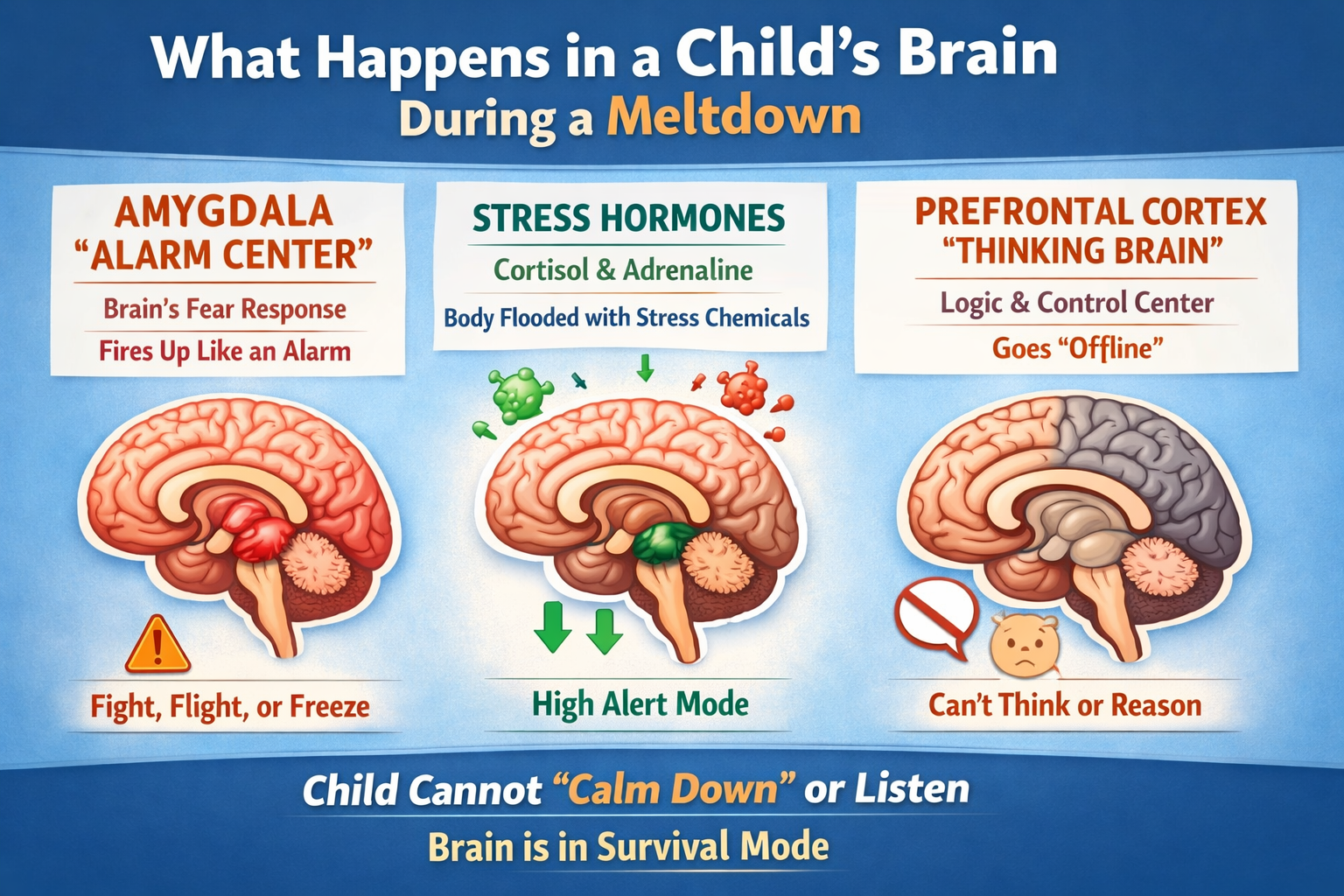
What’s Really Happening in Your Child’s Brain During a Meltdown
When your child is screaming, crying, or completely out of control, it can look like defiance, manipulation, or “bad behavior.” Many parents are told to correct it quickly—to discipline, reason, or demand calm.
But here’s the truth most parents are never taught:
A meltdown is not misbehavior. It’s a neurological stress response.
During a meltdown, your child isn’t choosing to act this way. Their brain is responding to perceived danger or overwhelm—often much faster than logic or language can catch up.
When a child melts down:
-
The amygdala (the brain’s alarm system) becomes highly activated
According to research on brain development Stress hormones like cortisol and adrenaline flood the bodyThe prefrontal cortex—the part of the brain responsible for logic, language, impulse control, and decision-making—temporarily goes offline.
What this means in real life:
Your child cannot listen, explain their feelings, or “calm down” on command in that moment—no matter how many times you ask or how calmly you say it.
This is why traditional discipline, lectures, or consequences often make meltdowns worse instead of better.
The way out of a meltdown isn’t correction first.
It’s regulation first.
Once the nervous system feels safe again, the thinking brain can come back online—and that’s when learning, reflection, and connection become possible.
The 5-Minute Brain-Based Meltdown Reset
⏱ Minute 0–1: Regulate Your Nervous System First
Your nervous system sets the tone.
Do this immediately:
-
Drop your voice (slower + softer)
-
Exhale longer than you inhale (4 in / 6 out)
-
Relax your jaw and shoulders
A dysregulated adult cannot regulate a child. Calm is contagious.
⏱ Minute 1–2: Create Safety (Not Solutions)
Your child’s brain needs felt safety, not words.
What helps:
-
Sit or kneel to eye level
-
Open body posture
-
Stay nearby without hovering
Say very little, or nothing at all.
Avoid:
-
“Stop crying”
-
“You’re fine”
-
“Talk to me”
These increase alarm signals in the brain.
⏱ Minute 2–3: Name the Feeling (This Is Brain Science)
Emotion labeling reduces amygdala activity.
Use simple, validating phrases:
-
“This feels really hard.”
-
“You’re so overwhelmed.”
-
“I see how upset you are.”
🧠 This is called affect labeling—it literally helps the brain calm itself.
📌 Expert tip:
Don’t ask questions. Statements feel safer than questions during stress.
⏱ Minute 3–4: Offer Body Regulation (Not Logic)
Meltdowns live in the body, not the mind.
Try one:
-
Deep pressure hug (if welcomed)
-
Slow rocking
-
Child pushes against your hands or a wall
-
“Smell the flower, blow the candle” breathing
🎯 Choose one technique only. Too many choices overwhelm the nervous system.
⏱ Minute 4–5: Stay Present Until the Wave Passes
Most meltdowns peak and fall within minutes when safety is present.
Your job:
-
Stay
-
Breathe
-
Don’t teach or lecture yet
Emotions move like waves.
Presence is what allows them to pass.
What NOT to Do During a Meltdown (Even If It’s Hard)
❌ Reason
❌ Threaten consequences
❌ Ask “why”
❌ Walk away to “teach a lesson”
❌ Shame (“Big kids don’t act like this”)
These keep the brain in survival mode longer.
After the Meltdown: The Golden Window (Important!)
Only after calm returns can learning happen.
Later (not immediately), you can say:
-
“What was hard about that moment?”
-
“What could help next time?”
-
“How can I support you better?”
This builds emotional intelligence, not fear.
Here is a polished, professional, website-ready version that flows smoothly, builds authority, and emotionally supports parents—while staying grounded in psychology and neuroscience:
Why This Works (From a Professional Perspective)
This approach isn’t based on trends or parenting styles—it’s grounded in how the developing brain actually works.
It relies on three key principles used in child psychology and trauma-informed parenting:
-
Nervous system regulation
Meltdowns resolve when the body feels safe, not when behavior is corrected. -
Co-regulation before self-regulation
Children borrow calm from a regulated adult before they can access it on their own. -
Developmental brain science
A child’s brain is still under construction. Emotional control develops through repeated experiences of safety and connection.
Children don’t learn calm through control, punishment, or reasoning in the heat of the moment.
They learn calm through connection.
A Gentle Truth for Parents
If meltdowns feel frequent, intense, or exhausting, it doesn’t mean you’re failing as a parent.
More often, it means:
-
Your child’s nervous system needs more support
-
And so does yours
Parenting isn’t about staying calm all the time. That’s not realistic—and it’s not required.
What truly supports a child’s emotional development is:
repair, safety, and connection—again and again.
And every moment of reconnection matters more than any moment of struggle.
Want Personalized Support?
If you’re dealing with:
-
daily meltdowns
-
aggression
-
emotional overwhelm
-
parenting burnout
A one-on-one session can help you understand your child’s unique nervous system and give you tools that actually work in your home.
You don’t have to figure this out alone.
Ready for Personalized Support?
If meltdowns are happening often—or feel overwhelming—you don’t have to figure this out alone.
Every child’s nervous system is different. What works for one family may not work for another. That’s why personalized guidance matters.
Book a Free 15-Minute Diagnostic Call
This short, no-pressure call is a space to:
-
Understand what’s really driving your child’s meltdowns
-
Identify your child’s emotional and nervous system needs
-
Clarify what kind of support would help your family most
This call is for parents who want clarity, not judgment.
Apply for Parenting & Child Psychology Support
If you’re looking for deeper help, you can apply for:
-
Parenting coaching
-
Child psychology consultation
-
Ongoing therapeutic support for emotional regulation, behavior, and connection
Together, we focus on calm, safety, and real change—for your child and for you.